Machine Learning Anomaly Detection and Recommender Systems
· (updated ) · Machine Learning · 6 minute read
Anomaly detection and recommender systems: Gaussian density estimation, collaborative filtering, and evaluation with precision and recall.
This post covers two important applications: anomaly detection for identifying unusual patterns and recommender systems for personalized predictions.
Anomaly Detection
Problem Motivation
Goal: Identify data points that deviate significantly from "normal" patterns
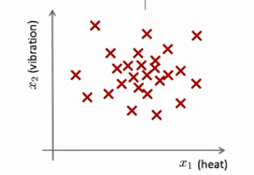
Example: Aircraft Engine QA
- Features x: Heat, vibration, etc.
- Training set: {x⁽¹⁾, ..., x⁽ᵐ⁾} from normal engines
- New engine x_test: Is it anomalous?
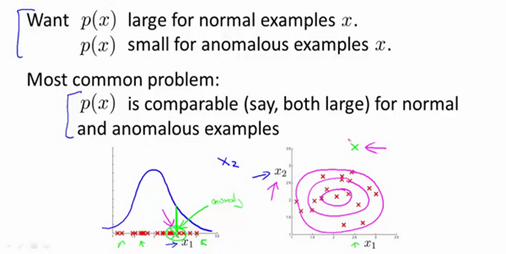
Approach: Build probability model p(x)
- If p(x_test) < ε: Flag as anomalous
- If p(x_test) ≥ ε: Consider normal
Applications:
- Fraud detection: Unusual user behavior
- Manufacturing: Defective products
- Data center monitoring: Failing computers
Gaussian Distribution

If x ~ N(μ, σ²):
$p(x; \mu, \sigma^2) = \frac{1}{\sqrt{2\pi}\sigma}\exp\left(-\frac{(x-\mu)^2}{2\sigma^2}\right)$
Parameter Estimation:
$\mu = \frac{1}{m}\sum_{i=1}^{m}x^{(i)}$
$\sigma^2 = \frac{1}{m}\sum_{i=1}^{m}(x^{(i)} - \mu)^2$
Note: In ML, using m instead of m-1 in variance is standard (makes little difference for large m)
Anomaly Detection Algorithm
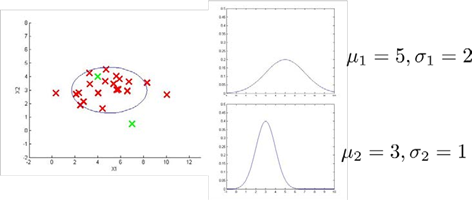
Assumptions: Features are independent and Gaussian
Model:
$p(x) = \prod{j=1}^{n}p(xj; \muj, \sigmaj^2)$
Steps:
- Choose features xⱼ that might indicate anomalies
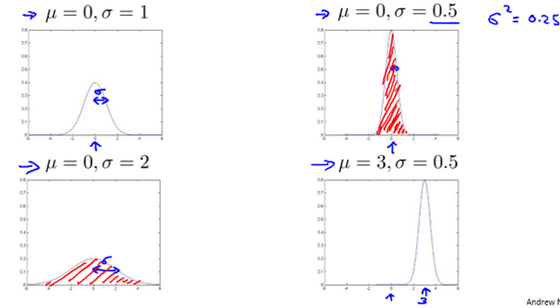
- Fit parameters μⱼ, σⱼ² for each feature j
- For new example x:
- Compute p(x) = ∏ⱼ p(xⱼ; μⱼ, σⱼ²)
- If p(x) < ε: anomaly
Evaluation and Development
Challenge: Evaluating unsupervised learning
Solution: Use small labeled dataset
Data Split Example:
- Training: 6,000 normal engines (unlabeled)
- CV: 2,000 normal + 10 anomalous (labeled)
- Test: 2,000 normal + 10 anomalous (labeled)
Evaluation Metrics:
- True positive, False positive, True negative, False negative
- Precision/Recall/F₁ score (better for skewed datasets than accuracy)
Parameter Selection:
Try different ε values on CV set, choose one maximizing F₁ score
Anomaly Detection vs. Supervised Learning
| Anomaly Detection | Supervised Learning |
|---|---|
| Very few positive (anomalous) examples | Many positive and negative examples |
| Many types of anomalies, future ones may differ | Enough positive examples to learn pattern |
| Hard to learn from positive examples | Future positives similar to training set |
| Use for: Fraud, failures, defects | Use for: Spam, weather, tumors |
Feature Engineering for Anomaly Detection
Key Success Factor: Good features!
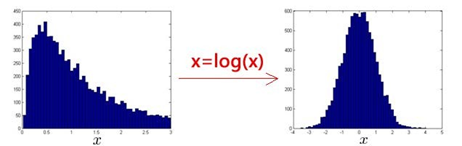
1. Non-Gaussian Features
Transform to more Gaussian:
- log(x)
- log(x + c)
- √x
- x^(1/k) for k=2,3,...
2. Error Analysis
If algorithm misses anomalies:
- Examine what makes them anomalous
- Create new features capturing that pattern
Example - Data Center:
- CPU load alone: May not detect stuck process
- Network traffic alone: May not detect stuck process
- New feature: CPU load / network traffic
- High ratio → anomalous (CPU busy but no traffic)
Guideline: Features should have:
- Normal: Intermediate values
- Anomalous: Very large or small values
Multivariate Gaussian Distribution
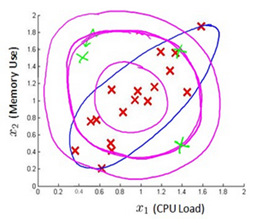
Motivation: Capture feature correlations
Standard model limitation: Features assumed independent
Multivariate Gaussian:
$p(x; \mu, \Sigma) = \frac{1}{(2\pi)^{n/2}|\Sigma|^{1/2}}\exp\left(-\frac{1}{2}(x-\mu)^T\Sigma^{-1}(x-\mu)\right)$
Parameters:
- μ ∈ ℝⁿ: Mean vector
- Σ ∈ ℝⁿˣⁿ: Covariance matrix
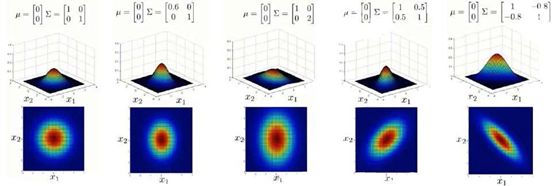
Covariance Matrix Effects:
- Diagonal elements: Control variance of each feature
- Off-diagonal elements: Control correlations
- Can model elliptical contours at any angle
When to Use:
| Standard Model | Multivariate |
|---|---|
| Manually create features for correlations | Automatically captures correlations |
| Computationally cheap, scales to large n | Computationally expensive |
| Works with small m | Requires m > n (typically m ≥ 10n) |
| Use this most often! | Use when correlations complex |
Recommender Systems
Problem Formulation
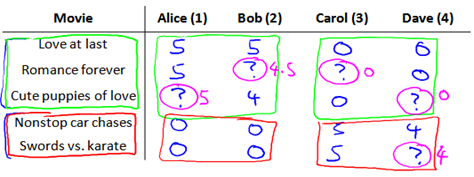
Movie Rating Example:
- nu users, nm movies
- r(i,j) = 1 if user j rated movie i
- y⁽ⁱ'ʲ⁾ = rating given by user j to movie i
Goal: Predict ratings for unseen movies, recommend highest predicted
Content-Based Recommendations
Assumption: Have features for each movie
Example Features:
- x₁: Romance level (0-1)
- x₂: Action level (0-1)
Model: For each user j, learn parameters θ⁽ʲ⁾
Prediction: (θ⁽ʲ⁾)ᵀx⁽ⁱ⁾ for user j, movie i
Cost Function (for user j):
$\min{\theta^{(j)}} \frac{1}{2}\sum{i:r(i,j)=1}((\theta^{(j)})^Tx^{(i)} - y^{(i,j)})^2 + \frac{\lambda}{2}\sum{k=1}^{n}(\thetak^{(j)})^2$
For all users:
$\min{\theta^{(1)},...,\theta^{(nu)}} \frac{1}{2}\sum{j=1}^{nu}\sum{i:r(i,j)=1}((\theta^{(j)})^Tx^{(i)} - y^{(i,j)})^2 + \frac{\lambda}{2}\sum{j=1}^{nu}\sum{k=1}^{n}(\theta_k^{(j)})^2$
Gradient Descent: Same form as regularized linear regression
Collaborative Filtering
Key Insight: Can learn both features x AND parameters θ!
Reverse Problem: Given θ, can we learn x?
$\min{x^{(i)}} \frac{1}{2}\sum{j:r(i,j)=1}((\theta^{(j)})^Tx^{(i)} - y^{(i,j)})^2 + \frac{\lambda}{2}\sum{k=1}^{n}(xk^{(i)})^2$
Collaborative Filtering Algorithm:
Simultaneously optimize x AND θ:
$\min{x,\theta} J(x,\theta) = \frac{1}{2}\sum{(i,j):r(i,j)=1}((\theta^{(j)})^Tx^{(i)} - y^{(i,j)})^2 + \frac{\lambda}{2}\sum{i=1}^{nm}\sum{k=1}^{n}(xk^{(i)})^2 + \frac{\lambda}{2}\sum{j=1}^{nu}\sum{k=1}^{n}(\thetak^{(j)})^2$
Steps:
- Initialize x and θ to small random values (break symmetry!)
- Minimize J using gradient descent (or advanced optimizer)
- For user j, movie i: predict (θ⁽ʲ⁾)ᵀx⁽ⁱ⁾
Why "Collaborative"?
Users collaborate to help system learn better features!
Vectorization: Low Rank Matrix Factorization
Rating Matrix Y: nm × nu matrix
Prediction Matrix:
$\text{Predictions} = X\Theta^T$
Where:
- X: n_m × n matrix (each row is x⁽ⁱ⁾ᵀ)
- Θ: n_u × n matrix (each row is θ⁽ʲ⁾ᵀ)
Finding Similar Movies:
Movie i similar to movie k if ||x⁽ⁱ⁾ - x⁽ᵏ⁾|| is small
Applications:
- Show "users who liked this also liked..."
- Features learned automatically (may not be interpretable)
Mean Normalization
Problem: New user Eve with no ratings
- All r(i, Eve) = 0
- Learned θ⁽ᴱᵛᵉ⁾ = [0,0,...,0] (from regularization)
- Predicts 0 for all movies!
Solution: Normalize ratings by subtracting mean
Steps:
- Compute μᵢ = average rating for movie i
- Create Y' = Y - μ (subtract μᵢ from each row)
- Learn x and θ on Y'
- Predict: (θ⁽ʲ⁾)ᵀx⁽ⁱ⁾ + μᵢ
For new user: Predict μᵢ (movie's average rating)
Key Takeaways
Anomaly Detection:
- Model normal behavior with Gaussian distribution
- Use small labeled set for evaluation (F₁ score)
- Feature engineering is critical
- Transform non-Gaussian features
- Create features that capture anomalous patterns
- Standard model usually better than multivariate
Recommender Systems:
- Content-based: Requires pre-defined features
- Collaborative filtering: Learns features automatically
- Low-rank matrix factorization for efficient computation
- Mean normalization handles new users (cold start)
- Can find similar items using learned features
- Random initialization breaks symmetry
Both techniques handle sparse data and are widely used in industry applications!